

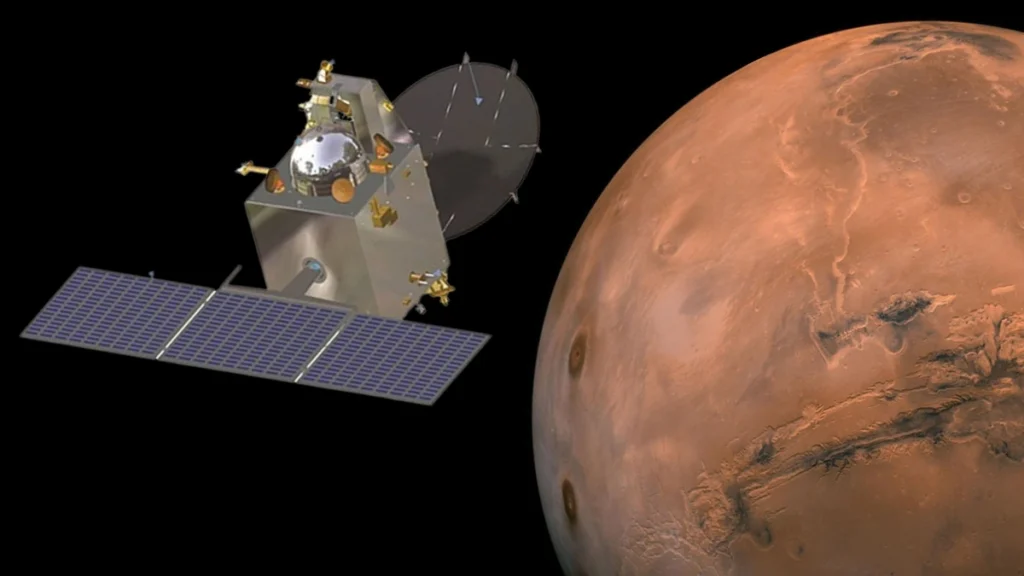
Let’s be honest, when you hear about a Mars mission, it’s easy to think, “Okay, cool, scientists doing science.” But here’s the thing: these missions aren’t just about dusty red rocks and potential aliens. They’re about our future, our technology, and even our understanding of life itself. This article isn’t just going to tell you about the next Mars mission; it’s going to dive deep into why it matters, especially for us here in India.
Decoding the “Why”: More Than Just a Space Race
So, why should you care about a bunch of robots and probes heading to a planet millions of kilometers away? Well, for starters, the technology developed for these missions often trickles down into our everyday lives. Think about it: advancements in solar power, communications, and even medical devices have roots in space exploration. What fascinates me is how these innovations, born out of necessity for surviving in harsh environments, can revolutionize sectors like renewable energy and healthcare here in India. It’s not just about planting a flag; it’s about fueling innovation back home. The development of advanced robotics for Mars Exploration, for instance, can lead to automation solutions applicable in Indian industries.
But it goes even deeper than that. Mars exploration helps us understand Earth’s past and future. By studying the Martian atmosphere and geology, scientists can gain insights into climate change and planetary evolution. This is particularly crucial for a country like India, which is highly vulnerable to the impacts of climate change. Understanding how Mars lost its atmosphere, for example, could offer valuable lessons for preserving our own planet.
And let’s not forget the inspiration factor! Seeing images of another world, knowing that humanity is pushing the boundaries of what’s possible – that can spark a passion for science and technology in young minds. Imagine the impact on students across India, seeing the tangible results of scientific inquiry. It’s about fostering a culture of innovation and exploration, nurturing the next generation of scientists and engineers who will tackle the challenges facing our nation.
The Indian Connection: A Growing Role in Space Exploration
India’s space program has made giant strides, and its contributions to future Mars missions will be significant. With missions like Mangalyaan, India has proven its capabilities in interplanetary travel at a fraction of the cost of other space agencies. The success of Mangalyaan wasn’t just a source of national pride; it also demonstrated India’s ingenuity and cost-effectiveness in space exploration. This is something to remember. It showcases that innovation doesn’t always require massive budgets; it requires clever thinking and resourcefulness.
As international collaborations become increasingly common in space exploration, India has the opportunity to play a vital role in future Mars missions. Whether it’s contributing scientific instruments, providing data analysis, or even participating in joint missions, India’s expertise is highly valued. This collaborative spirit not only strengthens our scientific capabilities but also fosters international goodwill and cooperation. India’s youth role is especially important.
The Search for Life: A Universal Question
One of the most compelling reasons to explore Mars is the possibility of finding evidence of past or present life. Astrobiology on Mars is not just a scientific curiosity; it’s a fundamental question about our place in the universe. Are we alone? Or is life a common phenomenon throughout the cosmos?
Even if we don’t find definitive proof of life, the search itself is invaluable. It pushes us to develop new technologies, refine our scientific methods, and expand our understanding of the conditions necessary for life to exist. And who knows? Maybe the next Mars mission will uncover something truly extraordinary – something that will change our understanding of life forever. The implications of discovering even microbial life on Mars would be profound, forcing us to rethink our understanding of biology and evolution.
Navigating the Challenges: A Realistic Perspective
Of course, exploring Mars is not without its challenges. The harsh environment, the vast distances, and the potential for equipment failure all pose significant obstacles. But these challenges are precisely what drive innovation. They force us to think creatively, to develop new solutions, and to push the boundaries of what’s possible. Space exploration is inherently risky, but the potential rewards – both scientific and technological – are immense. It is important to keep a realistic perspective on the challenges and celebrate the small victories along the way.
The one thing you absolutely must remember is that patience is key. Space missions take years of planning, development, and execution. There will be setbacks and unexpected challenges along the way. But it’s the perseverance and dedication of the scientists and engineers involved that ultimately lead to success.
FAQ About Mars Missions: Your Burning Questions Answered
Frequently Asked Questions
What is the primary goal of current Mars mission s?
The primary goal is to search for evidence of past or present life, study the planet’s geology and climate, and pave the way for future human missions.
How long does it take to travel to Mars?
A trip to Mars typically takes around six to nine months, depending on the alignment of the planets.
What are some of the biggest challenges of sending humans to Mars?
The biggest challenges include the long travel time, exposure to radiation, the effects of microgravity, and the need for self-sufficiency.
Are there any plans for future joint Mars mission s between India and other countries?
Yes, India is actively exploring opportunities for collaboration on future Mars missions with various international partners.
What kind of technologies are being developed for future Mars exploration ?
New technologies include advanced robotics, autonomous systems, improved life support systems, and more efficient propulsion methods.
How does Astrobiology on Mars help us understand life on Earth?
Studying potential life on Mars helps us understand the conditions necessary for life to arise and evolve, which can provide insights into the origins and evolution of life on Earth.
Conclusion: A Giant Leap for India, a Giant Leap for Mankind
The next Mars mission isn’t just about sending robots to another planet. It’s about pushing the boundaries of human knowledge, fostering innovation, and inspiring future generations. And as India continues to grow its presence in space, it has the opportunity to play a leading role in this grand adventure. This isn’t just about science; it’s about our future, our technology, and our place in the cosmos. What fascinates me is that space exploration and future human missions serve as a catalyst to bring out the very best of humanity. It encourages us to push ourselves to our limits and accomplish what we once thought was impossible.


